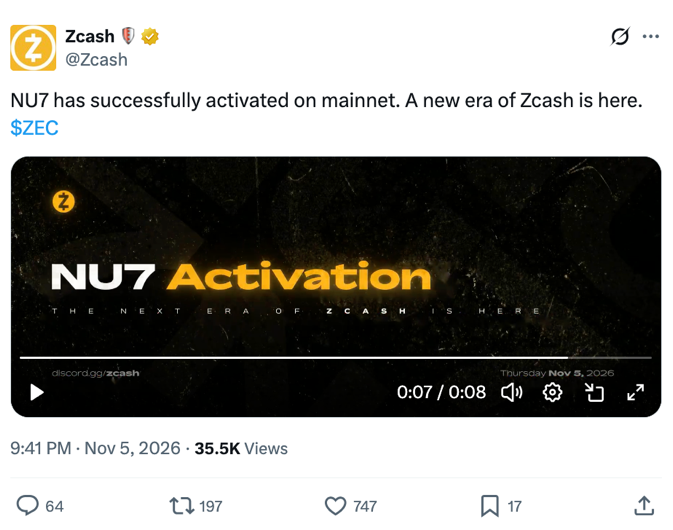
November 2026 Midterm Elections Update
Democrats have won control of the U.S. House of Representatives and the U.S. Senate, according to election reporting, setting up a divided government when the 120th Congress begins on January 3, 2027. President Trump will remain in office.
The 120th Congress is an opportunity to educate new and incumbent lawmakers about Zcash, financial privacy, self-custody, and developer protections, but it will be an uphill battle given the growing backlash towards crypto, particularly “big crypto.” Prominent Democrats have already previewed that the next two years will be marked by investigations into the Trump administration, and that includes crypto companies affiliated with the administration and Trump family.
Read the full article on the Zcash Community Forum (https://forum.zcashcommunity.com/t/november-2026-u-s-midterm-elections/58887) or on X (https://x.com/pgpzcash/status/2118130438225211872).
Why this matters for Zcash
For the Zcash ecosystem, the most consequential outcome is the forthcoming change in House and Senate committee leadership. Leadership decides which bills move forward and what those bills must contain. Our assessment is that broader crypto legislation, such as market structure legislation, will face tougher negotiations, while scrutiny of financial privacy and illicit finance are likely to increase. Narrower agreements on developer protections and other issues remain possible, but this will be more difficult to achieve, particularly when compared against the CLARITY Act negotiations, which saw the removal of key Blockchain Regulatory Certainty Act (BRCA) provisions. The BRCA clarifies that noncustodial blockchain developers are not money transmitters under the Bank Secrecy Act, and an important part of the legislation that shielded blockchain developers from criminal liability was removed prior to the Senate’s September 15 procedural vote.
Action Item
Please reach out if you have questions about the midterm election results and the impact on the Zcash ecosystem.
X Post of the Week
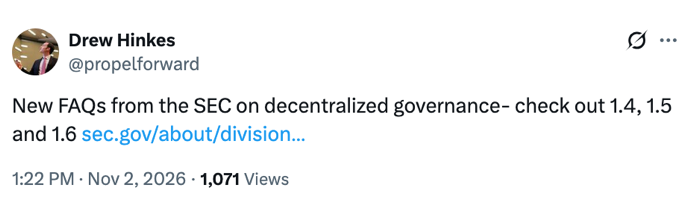
SEC Staff Distinguishes Independent Governance From Centralized Control
The SEC’s Division of Corporation Finance added three crypto-asset FAQs on November 2. For the Commission’s “digital commodity” interpretation, unaffiliated participants in broad-based governance generally are not considered a controlling group merely because they vote, including through a foundation, absent a separate agreement to coordinate. Delegation can still be relevant. Staff identifies unilateral authority over access, voting procedures, consensus participation or transaction reversal as evidence of oversight. It also distinguishes a system’s functionality from decentralization. The clarification offers a more specific framework for assessing control, but remains nonbinding staff guidance, creates no new obligations.
Why it matters for Zcash
For the ecosystem, the practical inquiry is who can exercise authority over a network or application. Community voting, grant administration, and the existence of a foundation should be assessed through their actual powers and relationships. Moreover, a token-voting label alone cannot establish independence. This is relevant to evaluating governance proposals; it is not an SEC classification of ZEC or approval of a particular arrangement.
Action Item
No action item at this time.
Relevant Post
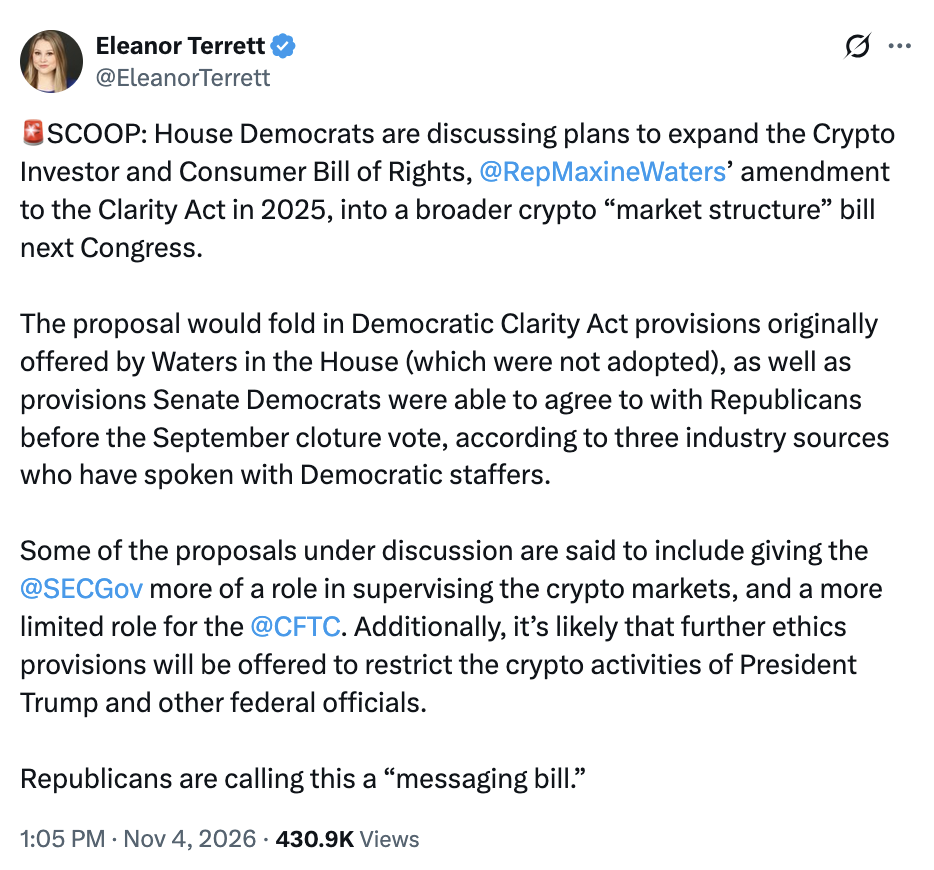
Election Results Change the Congressional Market-Structure Debate
Crypto In America reports that House Financial Services Democratic staff are developing an unpublished market-structure proposal drawing on Rep. Maxine Waters’ 2025 Crypto Investor and Consumer Bill of Rights amendment and subsequent Senate negotiations. Discussions reportedly envisage a larger SEC role and a more limited CFTC role than the CLARITY Act, alongside consumer protection and ethics provisions. Treatment of decentralized finance remains disputed. Note that a Democratic majority would strengthen agenda-setting power, but enactment would still require negotiations with Republicans and the administration.
Why it matters for Zcash
This is an opportunity to discuss how Zcash can promote effective consumer protection (e.g., via data minimization), lawful financial privacy, and clear distinctions between custodial intermediaries and people who publish or maintain noncustodial software.
Action Item
No action item at this time.
Relevant Post
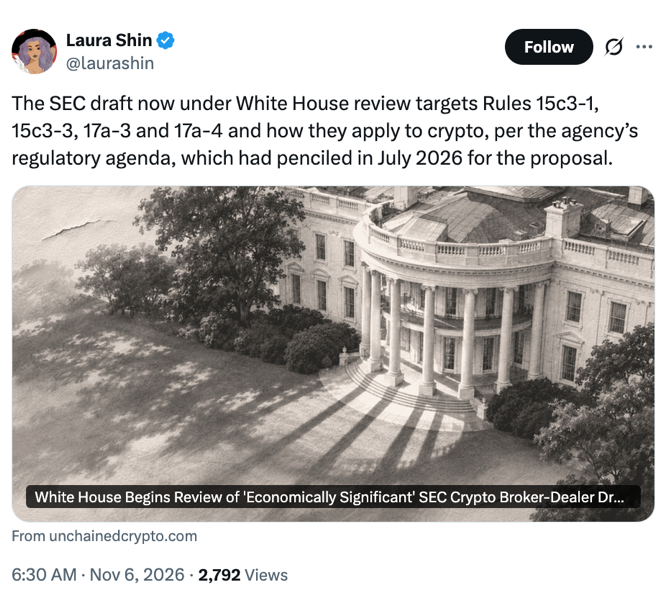
SEC Crypto Broker-Dealer Proposal Enters White House Review
A key agency tasked with reviewing regulatory proposals before they are published received the SEC’s proposed “Amendments to Broker-Dealer Financial Responsibility and Recordkeeping and Reporting Rules Regarding Crypto Assets.” White House review is an important procedural step toward a possible public proposal. The regulatory agenda identifies potential amendments to net-capital and customer-protection rules, together with broker-dealer recordkeeping rules. These subjects concern how registered firms safeguard customer assets, maintain financial resources and preserve records when handling crypto assets.
Why it matters for Zcash
For registered intermediaries considering ZEC-related services, clearer capital, custody, and recordkeeping treatment could affect the feasibility and cost of offering those services. The effects will depend on the proposal’s scope and the legal treatment of the assets and activities involved. Additionally, the recordkeeping component warrants attention to data security and financial privacy.
Action Item
No action item at this time.
Relevant Post
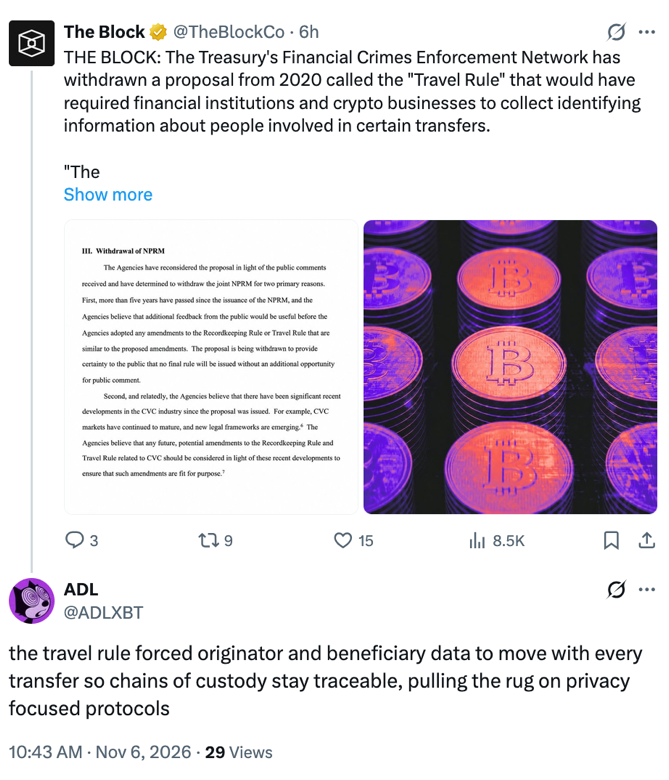
FinCEN and Federal Reserve Withdraw the 2020 Travel Rule Proposal
FinCEN announced that it and the Federal Reserve are withdrawing their October 2020 proposal on funds-transfer recordkeeping and the Travel Rule. The proposal would have lowered the relevant threshold from $3,000 to $250 for transfers beginning or ending outside the United States, and expressly addressed convertible virtual currencies and digital assets with legal tender status. The withdrawal notice is scheduled for Federal Register publication on November 9, when it becomes effective.
The agencies cite the age of the proposal, changes in digital asset markets and emerging legal frameworks, and the value of fresh public input before adopting similar amendments. They will not finalize this NPRM, and any renewed proposal would require another opportunity for comment. The notice records concerns about compliance costs, remittances and retention of personally identifiable information. Existing recordkeeping and Travel Rule obligations remain in place. The action removes a pending expansion of information collection rather than creating a general exemption for crypto transactions.
Why it matters for Zcash
Avoiding a lower threshold limits an additional source of identity data collection and transmission by covered institutions. That is relevant to Zcash users who interact with regulated services, because unnecessary copies of sensitive information can increase exposure to breaches and misuse.
Action Item
No action item at this time.
Relevant Post