Overview
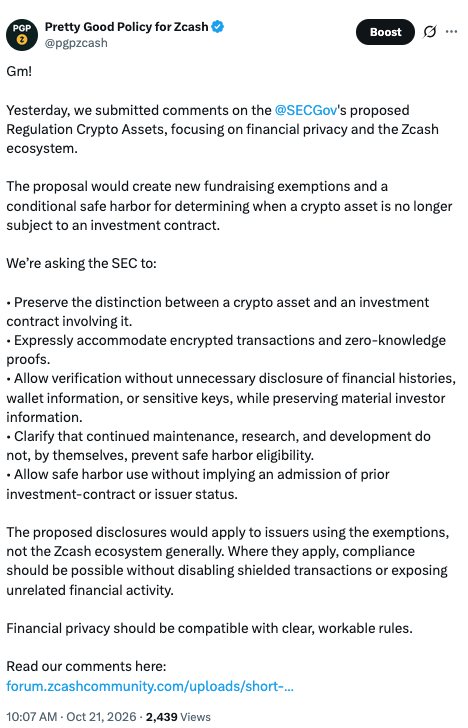
The Zcash Foundation announced on October 20 that its Board has appointed David Campbell Executive Director, succeeding Alex Bornstein. Alex, who joined as COO in 2021 and became Executive Director in March 2025, will remain in a transition role through the end of January 2027. In his community post, he emphasized cooperation across the ecosystem and said he plans to work more closely with the Financial Privacy Foundation after taking time off.
David brings security and operating experience, including four years as COO of Electric Coin Company and two years consulting with the Foundation. His stated priorities include keeping Zebra and Foundation infrastructure secure and reliable, and making privacy easier for ordinary people to use. The planned overlap provides continuity while he takes on the role.
We thank Alex for his service to the Foundation and the wider ecosystem, and welcome David to his new role.
X Post of the Week
PGPZ Submits Comments on SEC Regulation Crypto Assets
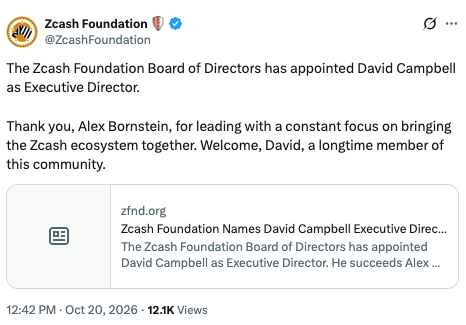
We submitted comments on the SEC’s proposed Regulation Crypto Assets. The proposal would create fundraising exemptions for certain investment contracts involving crypto assets and a conditional safe harbor under which an asset could be deemed no longer subject to an investment contract. Our response addresses questions focusing on the distinction between an asset and an investment contract, financial privacy and continued development.
We ask the SEC to preserve the distinction between an asset and an investment contract involving it and expressly accommodate encrypted transactions and zero-knowledge proofs in its definitions. For issuers using the proposed exemptions, disclosure rules should permit accounting records, cryptographic proofs, and selective disclosure that substantiate material claims without exposing unrelated financial activity. The letter seeks consistent protections for unnecessary wallet identifiers and transaction histories, and clarification that verification does not require disclosure of viewing keys or spending keys, disabling shielded transfers, or routing funds through transparent addresses.
We also ask the SEC to incorporate its continued-development explanation into Rule 400. Once the relevant conditions are met, maintaining, securing, improving or funding a functional network should not, by itself, prevent safe-harbor reliance. Unfinished essential promises and new promises would still matter. Filing should not imply an admission that an investment contract existed, that the asset was a security, or that the filer was its issuer; declining to file should create no adverse inference. These are recommendations for the final rule, and their adoption and timing remain uncertain.
Why it matters for Zcash
The objective is to let eligible ecosystem businesses raise capital and provide investors with material information while preserving financial privacy. Our recommendations focus on reducing unnecessary exposure of balances, commercial relationships, and personal associations without concealing material holdings or conflicts.
The letter also distinguishes transaction validity from evidence about use of investor funds (i.e., a cryptographic proof does not automatically establish every financial claim). Conventional records may still be needed, and requiring viewing key access should not be the default. Clarifying the treatment of continued development would give contributors greater certainty while preserving responsibility for actual promises to investors.
Action Item
Help us increase outreach and engagement by reposting/sharing our SEC comment letter.
Relevant Post