September Monthly Update on PGPZ
September marked an important step in PGPZ’s organizational development and preparation for sustained advocacy. We formally seated our Board of Directors, advanced operational and compliance work, and developed policy and educational materials to support engagement on financial privacy, privacy-preserving technologies, and developer protections.
September’s substantive policy work included:
- CLARITY Act and developer protections: Analyzing how proposed legislation would affect the Zcash ecosystem, with particular attention to protections for developers of decentralized technology and subsequent legislative developments.
- Texas electricity policy: Explaining why flexible proof-of-work mining should be distinguished from other large electricity users, particularly when facilities can reduce demand during periods of grid stress.
- Weekly policy updates: Continuing to share legislative and regulatory developments and provide opportunities for questions through our Public Policy and Regulatory Developments Q&A thread.
Why it matters for Zcash
September’s work strengthened PGPZ’s capacity to bring informed, technically grounded perspectives into policymaking. Our governance and operational processes support sustained advocacy, while the proposed ecosystem input process will help ensure that our positions reflect practical experience across the community.
The policy analyses and educational materials provide a foundation for explaining lawful uses of shielded transactions, distinguishing noncustodial software development from financial intermediation, and addressing the treatment of proof-of-work mining. October’s meetings and events will create opportunities to put that work directly before policymakers and their staff.
Action Item
Help shape our advocacy by sharing policy concerns, technical input, and practical examples of how financial privacy matters to you. Please also invite friends and colleagues to join the PGPZ Community and Coalition.
X Post of the Week
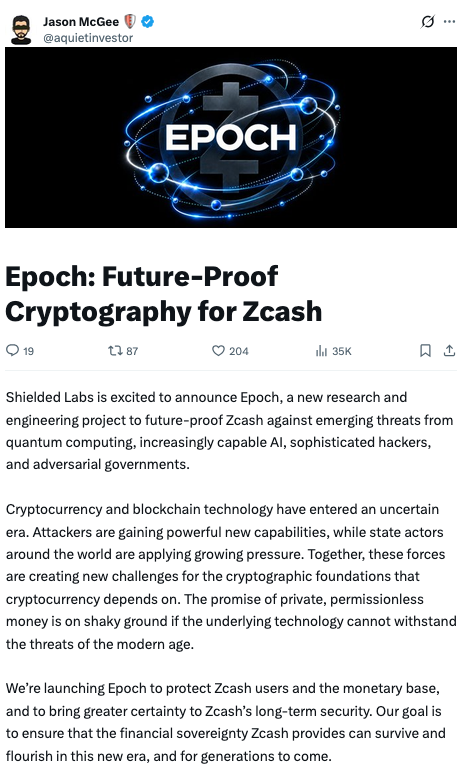
SEC Proposes Crypto Custody Framework for Investment Advisers and Funds
The Securities and Exchange Commission (SEC) proposed a tailored framework governing crypto-asset custody by registered investment advisers and regulated funds, including registered investment companies and business development companies. The proposal would permit self-custody under specified circumstances, allow state trust companies to custody client and fund crypto assets, and update requirements concerning financial-statement audits and broker-dealer custodial services. The initiative addresses a practical obstacle to institutional participation as custody arrangements designed for traditional securities do not always accommodate digital assets or the availability of custodial services. Comments will be accepted for 60 days following Federal Register publication, and the final framework will depend on the Commission’s consideration of operational risks, investor protections, and public feedback.
Why it matters for Zcash
Additional custody options could make it easier for advisers and funds to support ZEC, although they would not guarantee product approval or institutional adoption. A key policy question is whether custody safeguards can accommodate shielded assets.
Action Item
PGPZ may respond to this rulemaking. Reach out if you have any comments in support or in opposition of this proposed rulemaking.
Relevant Post
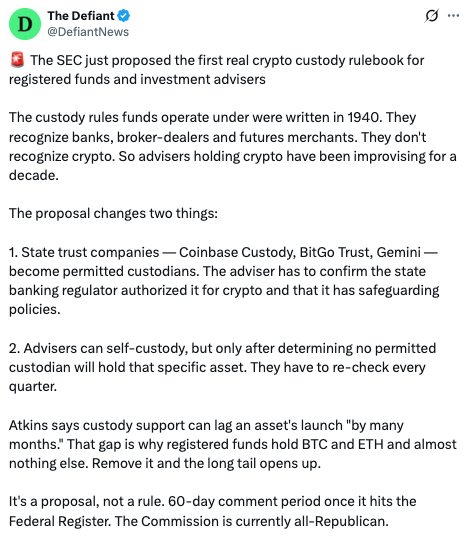
Daines Introduces Digital-Asset Tax Bill Combining Payment Relief With Wash-Sale Restrictions
Sen. Steve Daines (R-MT) introduced the Aligning Digital Assets with Principles of Taxation (ADAPT) Act, pairing targeted tax simplification with restrictions intended to align digital assets with traditional investments. The bill would eliminate gain-or-loss recognition for qualifying regulated dollar-stablecoin purchases of goods and services and for eligible crypto-paid transaction costs totaling $10 or less. It would also extend wash-sale and constructive-sale rules to covered digital assets and address lending, investment structures, and other tax questions. Its introduction provides a Senate counterpart to the digital-asset tax legislation recently advanced by the House Ways and Means Committee. However, the proposals differ materially, which means negotiators in the House and Senate must reconcile their scope, effective dates, and treatment of particular transactions.
Why it matters for Zcash
Eligible ZEC-denominated transaction fees could benefit from the $10 threshold, but that relief should not be confused with a general small-payment exemption. Proposed wash-sale restrictions would also affect covered ZEC investment transactions, subject to the bill’s exceptions and transition provisions.
Action Item
No action item at this time.
Relevant Post
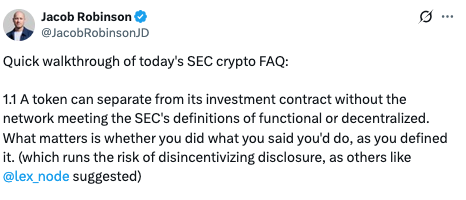
SEC and CFTC Continue Administrative Clarification Following the CLARITY Act Setback
SEC staff issued and updated FAQs addressing crypto-asset classification and investment contracts. The guidance explains that maintenance, security improvements, and development supporting an already functional network need not constitute the essential managerial efforts relevant to the securities law analysis. It also addresses staking receipt tokens, promotional statements, and buybacks; the September 28 buyback clarification expressly requires a functional system without a central party. Note that the FAQs represent staff views, have no legal force, and do not amend existing law. Separately, Commodity Futures Trading Commission (CFTC) staff updated guidance concerning investment of customer funds in tokenized forms of permitted investments and blockchain-based recordkeeping. Together, these actions demonstrate continued administrative work following the Senate’s failed CLARITY Act vote, but do not replace the statutory market-structure framework Congress has yet to enact.
Public Policy Implications for the Zcash Ecosystem
The SEC’s distinction between maintaining a functional network and promising essential managerial efforts is particularly relevant to Zcash’s developers and supporting organizations. It supports the argument that continued technical development should not, by itself, determine securities treatment. Nevertheless, the guidance neither classifies ZEC nor creates a general developer safe harbor. Its analysis remains separate from money-transmission, sanctions, and anti-money-laundering requirements. Zcash stakeholders should therefore distinguish useful securities-law clarification from the broader statutory protections sought for noncustodial software and decentralized infrastructure.
Action Item
Reach out if you have ideas for additional guidance for SEC and CFTC consideration.
Relevant Post
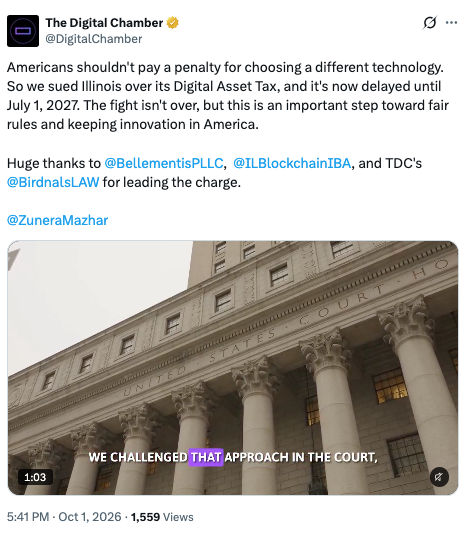
Illinois Agrees to Seek a Six-Month Delay of Its Digital-Asset Tax
Illinois officials and industry challengers have agreed to seek postponement of the state’s digital asset tax from January 1 to July 1, 2027, subject to court approval. The 0.2% tax applies to Illinois-based users and the companies that provide services to them and covers specified digital asset activities, including transactions from a hosted wallet to a self-custody wallet, when certain requirements are met. The agreement would allow the parties to focus on the underlying dispute over the tax’s constitutionality and enforceability rather than immediate implementation. Challengers also argue that federal law preempts the measure. The proposed delay is procedural relief, not repeal or a ruling accepting those arguments. If approved, it would reduce near-term compliance pressure while leaving the tax’s ultimate validity unresolved.
Why it matters for Zcash
A postponement could provide additional preparation time for covered businesses supporting ZEC and reduce immediate pressure to change services or pass compliance costs to customers. It would not resolve the broader concern that taxing transaction activity, rather than realized gains, can increase the cost of using digital assets. For the Zcash ecosystem, the litigation remains relevant to the affordability and availability of custodial services and transfers involving self-custody in Illinois. Stakeholders should not treat the agreement as either a permanent exemption or a final judicial outcome.
Action Item
No action item at this time.
Relevant Post
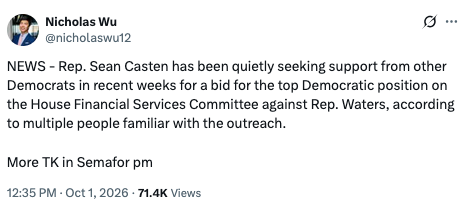
Casten Seeks Support for Potential House Financial Services Leadership Bid
Rep. Sean Casten (D-IL) has reportedly approached Democratic colleagues about a potential bid for the top Democratic position on the House Financial Services Committee, currently held by Rep. Maxine Waters. Rep. Casten has reportedly engaged in preliminary outreach, but has not announced his candidacy for the role. The outcome would depend on internal Democratic decisions, while control of the House would determine whether the position carries the authority of Chair or Ranking member. Rep. Casten has been a vocal critic of digital assets’ illicit-finance risks. His prior proposals include a temporary prohibition on financial institutions handling mixer-routed funds and the CODE Act, which would explore integrating AML, sanctions, and customer-identification controls into DeFi systems before subsequent FinCEN rulemaking. His record suggests that illicit finance and technology-based compliance would be important priorities if he obtained the position, although the leadership discussion itself changes no law.
Why it matters for Zcash
Rep. Casten’s interest merits attention because his earlier mixer legislation also proposed studying privacy coins and anonymity-enhancing technologies. A leadership role could give those concerns greater influence over hearings, oversight, and legislative negotiations. His potential advancement signals a policy risk to monitor, not a predetermined restriction on Zcash.
Action Item
No action item at this time.
Relevant Post
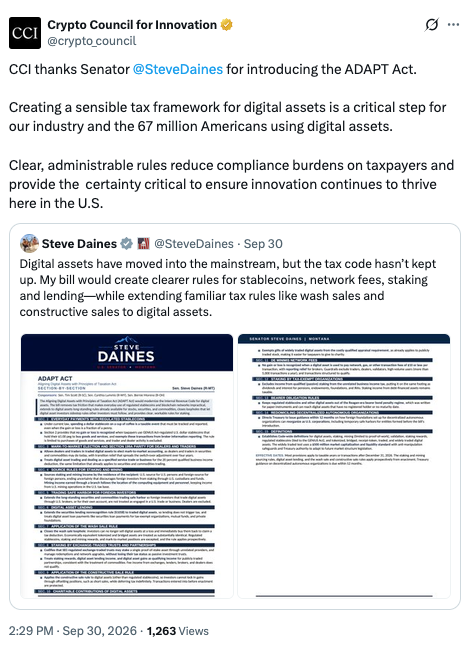
New York and Wyoming Agree to Coordinate Digital-Asset Supervision
New York’s Department of Financial Services and the Wyoming Division of Banking have announced a memorandum coordinating digital asset licensing, examinations, information sharing, and enforcement. Eligible firms operating under one regulator’s oversight for at least three years, without an enforcement action and with sufficiently similar proposed operations, may receive expedited consideration in the other state. The agreement sets a six-month decision target measured from the application or delivery of requested examination information, whichever is later. It does not establish automatic licensing reciprocity or guarantee approval. Each regulator retains its existing legal authority, and the memorandum creates no enforceable rights for applicants. Its practical significance is procedural: reducing duplicated review while improving coordination between two distinct regulatory systems.
Why it matters for Zcash
More coordinated supervision could reduce expansion costs for regulated businesses supporting ZEC, but the agreement does not itself support ZEC listings or shielding. For Zcash stakeholders, the implementation question is whether coordination reduces repetitive data requests while preserving proportionate, risk-based treatment of privacy-preserving technology.
Action Item
No action item at this time.
Relevant Post