X Post of the Week

CLARITY Act Fails Senate Procedural Vote After Last-Minute Negotiations
The Senate voted 49–50 against advancing the Digital Asset Market Clarity (CLARITY) Act, short of the 60 votes required to proceed with debate. The vote followed months of negotiations and a last-minute Democratic counteroffer, but the parties remained divided principally over ethics restrictions for senior federal officials with digital asset interests. Additional opposition concerned stablecoin rewards, state enforcement authority, and the Commodity Future Trading Commission’s (CFTC) treatment of prediction markets. The bill also lost several Republican votes and did not secure a simple majority, making successful reconsideration during the limited post-election session unlikely. A renewed effort remains possible, but enactment before the end of the 119th Congress, which follows a two-year cycle, would require a substantial political reversal; otherwise, market-structure legislation will need to be reintroduced in the next Congress. In the interim, policy development has already shifted toward the SEC and CFTC, however, their regulatory fixes cannot provide the same statutory durability or resolve all jurisdictional questions.
Why it matters for Zcash
The vote leaves Zcash without the CLARITY Act’s proposed statutory framework for classifying digital assets, allocating spot market authority, and protecting certain noncustodial software activity. The most recent draft would have provided civil regulatory protections for qualifying blockchain developers and service providers, but it did not include the earlier proposed clarification of criminal liability under 18 U.S.C. § 1960. It therefore would not have fully resolved the legal risk facing developers of privacy-preserving, noncustodial software. The vote’s failure means that even its narrower civil protections did not take effect. Agency action may improve conditions for particular products or intermediaries, but it cannot supply a comprehensive or durable developer safe harbor.
Action Item
No action item.
Relevant Post

House Committee Advances the Digital Asset Tax Certainty Act
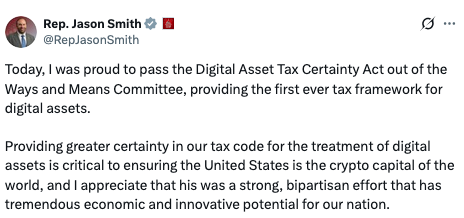
The House Ways and Means Committee voted 38–5 to advance H.R. 10357, the Digital Asset Tax Certainty Act, demonstrating substantial bipartisan support despite the CLARITY Act’s failure. The bill would clarify the tax treatment of digital asset transaction fees, accounting, stablecoins, lending, wash sales, mining, staking, and broker reporting. Its de minimis provision is narrower than a general exemption for small purchases. The Joint Committee on Taxation’s description states that it would generally prevent recognition of gain or loss when digital assets are disposed of to pay qualifying network or transaction fees of no more than $10, beginning after 2027. The measure would also extend certain tax rules applicable to traditional financial assets and clarify the source and ordinary-income character of mining and staking income. Committee approval materially improves the bill’s position, but it must still pass the House and Senate during a short remaining legislative calendar. Enactment this year is therefore uncertain, although the bipartisan vote may give the proposal a stronger basis for renewed consideration if it does not advance before Congress adjourns.
Why it matters for Zcash
If enacted, the fee provision could reduce tax-recordkeeping burdens when ZEC is used to pay qualifying network or transaction fees, but it would not create a general tax exemption for purchases made with ZEC. Zcash miners would be directly affected by the proposed sourcing and ordinary-income rules for validation activity, while ZEC traders could face expanded wash-sale and constructive-sale requirements.
Action Item
PGPZ plans to support this legislation and its outcome from the markup. Let us know how this legislation would impact you and whether you’d like to see any changes reflected in the bill.
Relevant Post
CFTC Staff Extends Conditional No-Action Relief to Passive Software Providers
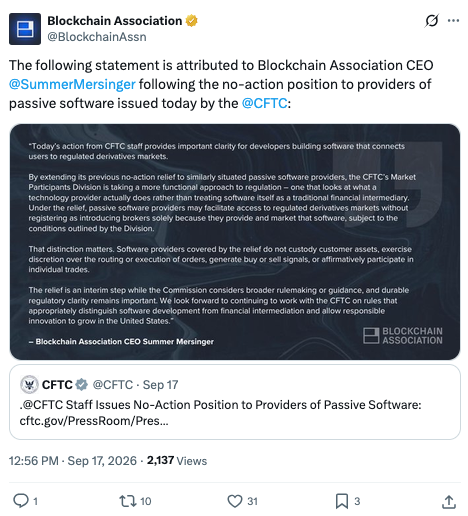
The CFTC’s Market Participants Division issued Staff Letter No. 26-25, extending to similarly situated passive software providers the no-action position it previously granted to Phantom Technologies. Until CFTC rulemaking or guidance becomes effective, division staff will not recommend enforcement for failure to register as an introducing broker, or for relevant personnel to register as associated persons, solely because a qualifying provider supplies or markets software through which users access CFTC-regulated derivatives offered by registered entities. The relief can apply to standalone interfaces or software embedded in self-custodial wallets, and providers may receive transaction-based compensation. However, the staff letter is narrowly conditioned, stating that the provider must remain passive, may not custody assets, generate trading signals, or exercise order-routing or execution discretion, and must satisfy disclosure, marketing, recordkeeping, notice, and other requirements. The provider and participating registrant must also accept joint and several liability for violations connected to the covered activity. Note that the letter is a staff enforcement position rather than a Commission rule, which means it is fact-dependent, temporary, and subject to modification or withdrawal rather than a durable regulation.
Why it matters for Zcash
The letter provides a useful regulatory distinction between passive software and financial intermediation. A qualifying Zcash wallet could potentially embed access to derivatives offered by registered CFTC entities without the wallet provider becoming an introducing broker solely for that activity, even if the interface is marketed or generates transaction-based fees. The relief does not cover ordinary ZEC transfers, spot-market activity, custody, investment advice, discretionary routing, money-transmission obligations, anti-money-laundering requirements, or criminal liability, and it should not be understood as a general safe harbor for wallet or protocol developers. Its operational conditions, particularly the required undertaking of joint and several liability, may also limit practical reliance. Still, the approach offers a potentially constructive model for future rules that assess software providers according to custody, control, and transaction-specific conduct rather than treating publication of noncustodial software as regulated intermediation.
Action Item
No action item.
Relevant Post