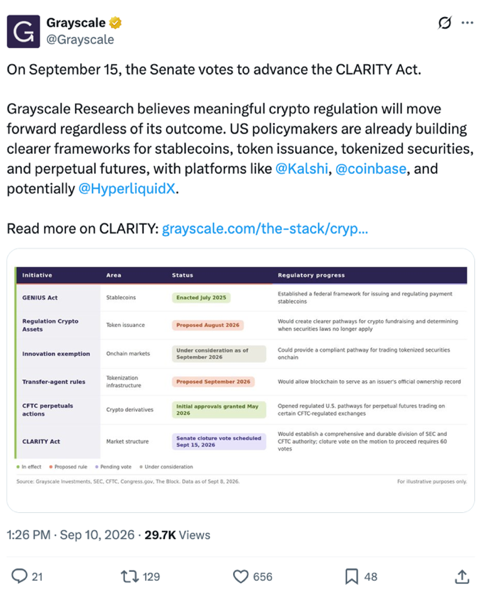
X Post of the Week

Revised CLARITY Act Text Arrives Before a Pivotal Senate Vote
Senate Republicans released an updated, 630-page substitute for the CLARITY Act, days before the Senate is scheduled to vote on whether to invoke cloture on the motion to proceed, which limits debate and overcomes a filibuster so the chamber can move toward a final vote. The revised text adds decentralized-finance provisions, among other things, but it does not change the White House-supported ethics title or the stablecoin rewards provisions that have contributed to opposition among Democrats and some Republicans. Cloture requires 60 votes, which means that with at least two Republican senators expected to oppose the procedural motion, proponents would need support from at least nine Democrats, several of whom have conditioned their votes on stronger ethics restrictions. Prosecutors’ organizations also continue to object to the Blockchain Regulatory Certainty Act, while negotiations over vertical integration in the Agriculture title remain incomplete. Even if the Senate advances and passes the measure, the House would have to approve the Senate’s revisions, and its shortened September schedule makes action before the post-election session unlikely. The new text improves legislative readiness and resolves some drafting questions, but it does not remove the principal political obstacles; the September 15 vote’s passage therefore remains uncertain. The revised Senate text is publicly available.
Developer Protection-related Changes in the September Draft
A comparison of the July 22 and September 10 texts shows that the developer provisions were reorganized rather than uniformly expanded or narrowed:
- Core software and network activity retains broad protection. Developers, publishers, transaction validators, node and oracle operators, providers of computational work or network bandwidth, and publishers of self-custody software generally would not become subject to the Commodity Exchange Act solely because they perform those activities. The phrase “solely based on” is important: the protection attaches to the listed conduct and would not immunize separate custodial, brokerage, dealing, or controlling activity.
- Post-deployment decentralized-finance activity receives a narrower safe harbor. The July text generally protected user interfaces, protocol administration, messaging systems, smart-contract liquidity pools, and wallet-related operations from the Commodity Exchange Act as a whole. The September text protects those activities only from the Act’s digital-commodity cash- and spot-market provisions. This change preserves meaningful protection for nonintermediary activity but creates greater potential exposure when a person moves beyond publishing code and actively operates or maintains a trading interface or protocol.
- A control-based framework replaces categorical treatment of operational DeFi. A protocol could be treated as a “non-decentralized finance trading protocol” if a person or coordinated group can materially alter its operation, if transactions are not governed solely by transparent pre-established code, or if an operator can restrict or censor use. The CFTC, in consultation with the SEC and Treasury, would establish tailored requirements for controlling persons based on the financial functions they perform. Bank Secrecy Act obligations would attach only to controlling persons required to register and treated as financial institutions under preexisting law. The bill expressly protects First Amendment interests in creating, publishing, and using code; prohibits requiring software or a distributed-ledger system to register in its own capacity; and bars rules that would prohibit launching, deploying, or operating a protocol.
- Additional safeguards improve legal predictability. The September text states that the section does not expand CFTC jurisdiction or create a presumption that a person or activity is regulated. It preempts inconsistent state securities, commodities, and digital-asset laws for protected activities, while preserving state anti-money-laundering, antifraud, and anti-manipulation authority, and it applies the safe harbor to conduct occurring before, on, or after enactment. It also generally treats governance participants as separate persons and provides that participation in a security council—or use of a predefined, temporary, rules-based emergency response—does not by itself establish control, provided the response is authorized through publicly disclosed on-chain mechanisms, narrowly limited to a documented cybersecurity incident, and not used for unrelated protocol, governance, or economic changes.
- The separate money-transmitter protection remains politically unresolved. Section 20209 concerns civil regulation under the Commodity Exchange Act. The Blockchain Regulatory Certainty Act, in Section 10604, separately provides that a noncontrolling developer or infrastructure provider is not a money transmitter solely because it publishes software, supplies self-custody tools, or supports a distributed ledger. Prosecutors’ groups continue to oppose that provision and that a key Democratic senator has not publicly changed her position. The September revisions to the CFTC safe harbor therefore do not eliminate the principal legislative risk to noncustodial-developer protection.
Why it matters for Zcash
The core safe harbor’s retention in the September 10 version is helpful for the ecosystem. This is because developing software that shields transactions, validating transactions, operating network infrastructure, or publishing tools that allow users to control their own ZEC would not, by themselves, create Commodity Exchange Act obligations. Federal preemption and retroactive application would also reduce uncertainty arising from conflicting state regulatory theories. These protections remain activity-specific, however, as a person performing custody, brokerage, dealing, transaction execution, or other intermediary functions could still be regulated on the basis of that separate conduct.
The narrower treatment of post-deployment interfaces and operational DeFi activity warrants closer attention for ecosystem stakeholders. A wallet developer or interface operator that also administers trading functions may receive less comprehensive protection than a developer who only writes and publishes software. Accordingly, future CFTC and Treasury rulemakings for persons controlling non-decentralized trading protocols will be important. Those proceedings should distinguish protocol development and privacy-preserving infrastructure from financial intermediation and should not convert Bank Secrecy Act obligations applicable to a controlling intermediary into protocol-level requirements for universal identification, transaction tracing, or modification of shielded transactions.
Action Item
Call your senators and tell them to pass the CLARITY Act with the developer protections and the Blockchain Regulatory Certainty Act included.
Relevant Post