X Post of the Week

August Monthly Update on PGPZ
August built on July’s congressional submissions and coalition engagement momentum, with PGPZ submitting comments to the Financial Crimes Enforcement Network (FinCEN) and the federal banking regulators joint notice of proposed rulemaking (NPRM), addressing how the federal government should implement customer-identification requirements for permitted payment stablecoin issuers without extending those requirements to decentralized protocols, noncustodial technology, or persons who have no direct relationship with an issuer.
The central question in the NPRM is how the agencies define a PPSI’s “customer” and “account.” A rule focused on persons who establish direct account relationships with an issuer could apply familiar customer-identification safeguards to issuance, redemption, custody, and related services. A broader interpretation could instead attempt to treat secondary-market holders as customers of an issuer merely because they possess or transfer its stablecoin, even when the issuer has no contractual, custodial, issuance, or redemption relationship with them.
Here are the key takeaways:
- PGPZ supports effective, risk-based customer identification requirements for PPSIs provided they remain focused on customers who establish a direct account relationship with an issuer. We offer an alternative definition for FinCEN and the agencies' consideration.
- The final rule should not treat secondary-market holders as customers merely because they own or transfer a stablecoin without a direct, contractual, custodial, issuance, or redemption relationship with the issuer.
- The Agencies should use technology-neutral definitions and preserve the GENIUS Act’s exclusions for decentralized protocols, noncustodial software, validators, and other non- intermediary infrastructure.
- Privacy-preserving technologies, including shielded transactions, zero-knowledge proofs, selective-disclosure credentials, and self-custodial wallets, should not, standing alone, be treated as indicators of heightened risk.
- The CIP rule should be harmonized with the companion AML/CFT and sanctions proposal so that monitoring and lawful-order obligations do not become a backdoor requirement to identify every stablecoin holder, trace every transaction, or modify general-purpose protocols.
- PPSIs should be permitted to use privacy-preserving verification methods while collecting and retaining only the information reasonably necessary to verify their customers; routine collection of wallet addresses or viewing keys should not be required.
- The final framework should reduce duplicative identity repositories, improve customer privacy notices and error-correction procedures, provide workable flexibility for smaller issuers, and fully account for privacy, cybersecurity, and implementation costs.
- Although no Zcash-based payment stablecoin currently exists, these rules could materially affect the design of future Zcash Shielded Assets and other privacy-preserving financial products.
Why it matters for Zcash
The comment letter advances several priorities relevant to the Zcash ecosystem.
- The final rule could establish an important boundary between regulated issuer activity and decentralized secondary-market activity. A direct-relationship standard would allow PPSIs to identify their own customers without making issuers responsible for persons who acquire stablecoins through unrelated platforms or peer-to-peer transfers.
- The comment letter introduces Zcash-relevant privacy tools, including zero-knowledge proofs, viewing keys, selective disclosure, and self-custodial wallets, into a formal federal rulemaking concerning the future architecture of digital payments.
- The recommendations support data minimization and cybersecurity by discouraging unnecessary repositories of identity, wallet, and transaction information. Limiting collection to information reasonably required for a defined compliance purpose can reduce both privacy risks and the consequences of a data breach.
- The filing seeks to protect developers and infrastructure participants by urging the agencies to respect the GENIUS Act’s distinctions among issuers, financial intermediaries, decentralized protocols, validators, and noncustodial software providers.
- Although the proposal does not presently regulate a Zcash-based stablecoin, the definitions adopted now may shape whether future Zcash Shielded Assets can combine regulated issuance and redemption with private, decentralized secondary-market transfers.
Action Item
Read and share PGPZ’s comment letter, and invite others who support financial privacy and responsible digital-asset policy to join the PGPZ Community and Coalition.
G20 Members Support “Clear Pathways” for Digital-Asset Innovation
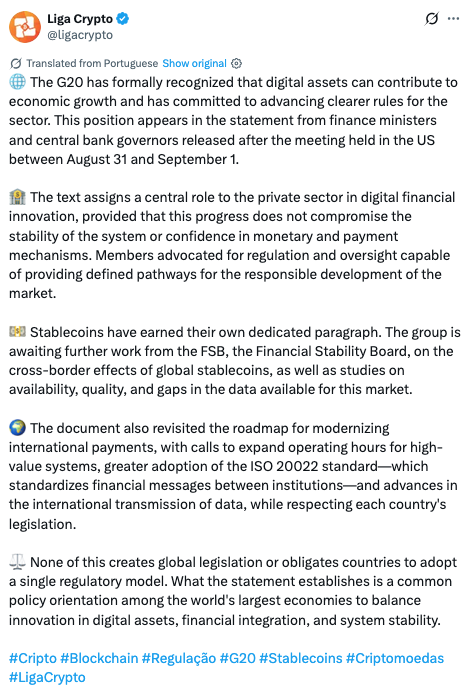
G20 finance ministers and central bank governors recognized the potential of digital assets to support broad-based economic growth and committed to advancing regulatory and supervisory frameworks that preserve financial stability while establishing clearer pathways for responsible innovation. TheG20 Chair’s Statement also reaffirmed the G20 Roadmap for Enhancing Cross-border Payments, including expanded operating hours for large-value payment systems, broader use of the ISO 20022 messaging standard, and improved cross-border transmission of financial-services data subject to data-security protections and domestic law. Separately, the G20 called for priority implementation of Financial Action Task Force standards in jurisdictions with significant virtual-asset activity and welcomed forthcoming Financial Stability Board work concerning global stablecoin arrangements and data availability. The statement is a nonbinding political commitment and does not itself change any laws or regulations. However, it signals that G20 members are likely to continue developing domestic digital asset frameworks around common financial stability, cross-border payment, and anti-money-laundering principles. The pace and substance of implementation will vary by jurisdiction.
Why it matters for Zcash
The G20’s recognition that digital assets can promote economic growth and more efficient cross-border payments is generally helpful for the digital asset industry.
However, the commitments concerning FATF implementation, information sharing, and cross-border transmission of financial-services data could encourage broader collection and exchange of customer and transaction information. Zcash stakeholders should therefore emphasize data minimization, secure transmission, and purpose-limited access as part of regulatory modernization. For future Zcash Shielded Assets, the FSB’s work on stablecoin data and cross-border arrangements may become particularly relevant.
Action Item
No action item.
Relevant Post
National Sheriffs’ Association Withdraws Its Opposition to the CLARITY Act
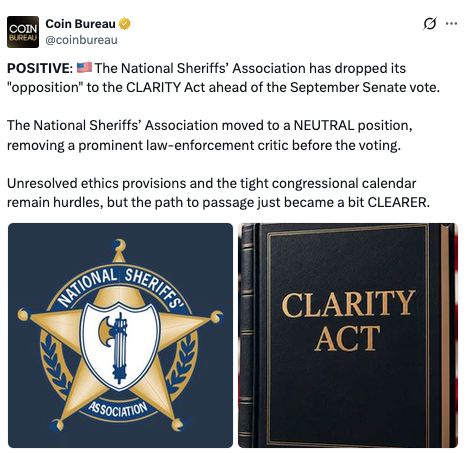
The National Sheriffs’ Association has changed its position on the CLARITY Act from opposition to neutral, stating that it will step back and allow the legislative process to proceed while important details remain under consideration. The association had been one of the most prominent law-enforcement organizations opposing the bill, arguing that protections for certain decentralized-finance developers and service providers could complicate illicit-finance investigations and prosecutions.
Why it matters for Zcash
The association’s change in position directly impacts the Zcash ecosystem because the disputed provisions address protections for developers and service providers that do not control users’ assets or independently execute transactions on their behalf. Accordingly, this reduces political pressure to eliminate or substantially narrow protections for open-source developers, noncustodial wallet providers, node operators, and other infrastructure participants.
Action Item
Call your senators and tell them to pass the CLARITY Act with the developer protections and the Blockchain Regulatory Certainty Act included.
Relevant Post