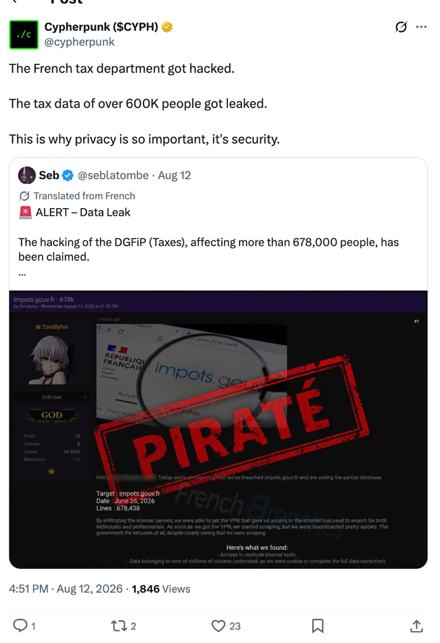
X Post of the Week
CFTC to Explore Crypto Regulation Beyond the CLARITY Act
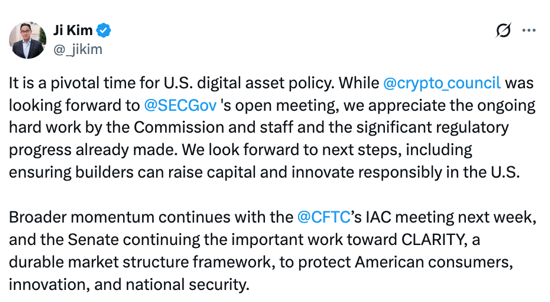
The Commodity Futures Trading Commission (CFTC) will convene its inaugural Innovation Advisory Committee on August 20 to examine cryptocurrency, artificial intelligence and prediction-market policy. The meeting will consist of three substantive sessions. The first will examine the evolution of digital asset regulation, including state licensing requirements, overlapping jurisdiction, regulation through enforcement, actions available under existing statutory authority and the development of a durable federal market-structure framework. It will also address cybersecurity, operational resilience and digital asset infrastructure. The second session will consider artificial intelligence in trading, compliance, surveillance and risk management, including autonomous financial agents and the intersection between AI and digital assets. The final session will address prediction markets, federal and state jurisdiction, product design, surveillance, manipulation and customer protection. The committee is advisory and the agenda does not provide for a vote on binding rules. The meeting may inform later guidance or rulemaking and help the CFTC prepare for future legislation, but it will not independently advance the CLARITY Act through Congress.
The agenda includes consideration of regulatory actions the CFTC could take under its existing authority to complement future legislation. The meeting reflects an effort to provide incremental administrative clarity after the Senate postponed consideration of the CLARITY Act until after its August recess. Such measures could support implementation planning and clarify selected compliance questions, but they cannot fully establish the statutory division of authority between the CFTC and Securities and Exchange Commission (SEC) or provide the durability of enacted legislation. The SEC initially scheduled a meeting on a tailored offering framework for certain crypto assets for August 14, butReuters subsequently reported that the SEC postponed that meeting because of a scheduling issue. Administrative work may continue if congressional action remains delayed.
Why it matters for Zcash
CFTC regulation, staff guidance, and no-action letters could improve regulatory predictability for intermediaries offering ZEC-related trading or derivatives products. Note that this would not resolve questions under Treasury and FinCEN authorities concerning shielded transactions, anti-money-laundering controls, self-hosted wallets or noncustodial software. Administrative policy may provide near-term assistance, but statutory protections would remain more durable.
Action Item
As the CFTC considers rulemakings and requests feedback, let us know if you have any comments or concerns.
Relevant Post
Bank Lobbying Adds Republican Pressure to the CLARITY Act Debate
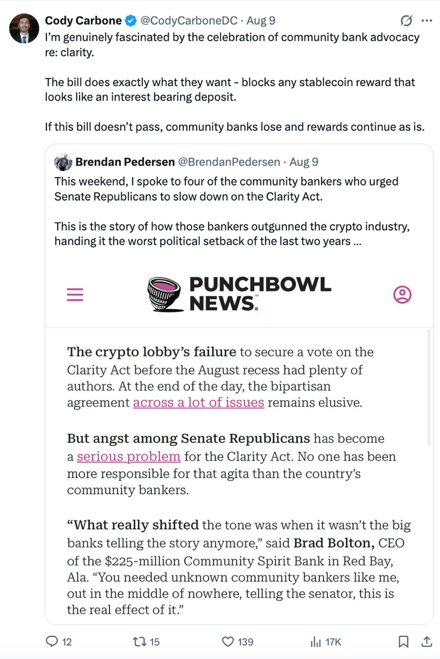
Banking advocacy organizations are using the congressional recess to press Republican senators for tighter restrictions on rewards paid to stablecoin holders, arguing that such programs could draw deposits away from banks and reduce lending capacity. Digital asset companies and their congressional allies contend that an earlier compromise negotiated by Senators Thom Tillis (R-NC) and Angela Alsobrooks (D-MD) adequately addressed passive-balance yield and that broader restrictions would principally protect incumbent financial institutions from competition. Republican supporters of the CLARITY Act expect sufficient party support to begin floor consideration, but bank opposition could still produce defections or demands for additional amendments. The more consequential hurdle remains the need for Democratic votes to reach the Senate’s 60-vote procedural threshold, including an agreement on ethics provisions addressing federal officials’ digital asset interests. Bank lobbying consequently increases drafting and scheduling risk during an already limited September legislative window, but it would not necessarily defeat the bill if Republicans remain largely unified and negotiators secure sufficient Democratic support.
Why this matters for Zcash
The stablecoin rewards dispute does not directly concern ZEC, but it is delaying a broader bill that could determine CFTC spot-market authority, exchange obligations and protections for developers, self-custody and noncustodial activity. Prolonged negotiations therefore extend regulatory uncertainty for ZEC-related listings and services. Any compromise should keep restrictions on stablecoin rewards confined to fiat-referenced payment products. Broad definitions of “rewards” or “yield” should not create unintended uncertainty for unrelated arrangements, including Zcash’s proof-of-work block rewards or exchange programs involving ZEC.
Action Item
Call your senators’ offices to advocate for the passage of the CLARITY Act and join the PGPZ Coalition Market Structure Working Group.
Relevant Post
White House to Host Cryptocurrency and Prediction-Market Executives
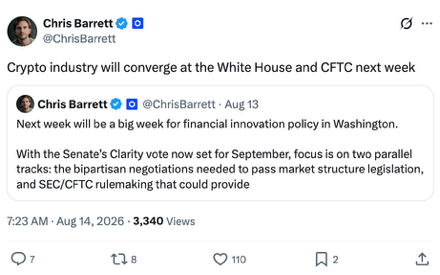
The White House is expected to convene digital asset and prediction market executives on August 19, one day before the CFTC’s Innovation Advisory Committee meeting. Traditional financial institutions may also participate, although the guest list, agenda and President Trump’s attendance remained unsettled. The gathering indicates continued Executive Branch engagement with fintech companies while the CLARITY Act awaits Senate consideration in September. Its proximity to the CFTC meeting may allow industry concerns and administrative priorities to be coordinated, but the White House meeting is informal and does not itself constitute rulemaking, legislation or an enforceable policy commitment. Its significance will depend on whether participants identify compromises or regulatory proposals that can subsequently be incorporated into formal legislative or agency processes.
Why this matters for Zcash
The practical significance for Zcash will depend substantially on representation and subject matter. Large exchanges and prediction market firms may prioritize market access, stablecoins and event contracts rather than privacy-preserving digital cash. Unless the meeting produces a formal follow-up process, it creates no immediate change for ZEC users, developers or exchange listings.
Action Item
No action item.
Relevant Post