X Post of the Week
July Monthly Update on PGPZ
July marked PGPZ’s transition from initial organizational development toward sustained public education, policy monitoring, and direct advocacy. PGPZ expanded that foundation through new community resources and interventions concerning federal market structure, financial-crime oversight, state taxation, and electricity policy.
PGPZ launched or substantially updated four public-facing resources:
ZEC Shelf: A centralized collection of educational and policy resources, including materials explaining how Zcash works. The feature is intended to make reliable background information easier for community members, policymakers, and external stakeholders to locate.
X Monitor: A monitoring tool through which Community and Coalition members can follow Zcash-related posts on X and identify emerging policy discussions, misconceptions, and opportunities for engagement.
Topic Briefings: FAQ-style collections of curated questions and answers intended to provide accessible and consistent explanations of recurring Zcash and public-policy issues.
Community Page Refresh: The PGPZ Community homepage was updated to improve access to policy materials, monitoring tools, briefings, and opportunities for participation.
These developments principally improve PGPZ’s organizational and communications capacity. They do not themselves change public policy, but they provide infrastructure for faster issue identification, more consistent public explanations, and more informed participation by Community and Coalition members.
We prepared and published statements for the record in connection with the House Financial Services July 17 CLARITY Act hearing and the July 21 FinCEN oversight hearing. The submissions represent a step beyond general policy commentary by directing Zcash-specific perspectives toward formal congressional oversight and legislative discussions.
PGPZ and participants from across the Zcash ecosystem prepared for submission a coalition letter to Senate Majority Leader John Thune and Democratic Leader Charles Schumer supporting H.R. 3633, the Digital Asset Market Clarity Act of 2025. The letter urged the Senate to bring the legislation to the floor while preserving its treatment of network tokens and the developer protections contained in the Blockchain Regulatory Certainty Act.
We issued a statement opposing the Illinois Digital Asset Tax Act enacted as part of the state’s fiscal year 2027 budget legislation. According to the statement, the Act taxes covered exchanges, transfers, and storage activity based on the value of the digital assets involved rather than on whether a user realizes income or profit. PGPZ argued that the structure could apply repeatedly across related activities, including a transfer from a custodial platform to a noncustodial wallet.
We also published a statement opposing a one-size-fits-all approach to large electricity loads in Texas. The statement addressed Texas Senate Bill 6, related Public Utility Commission of Texas proceedings, and a proposed change to the state’s transmission-cost methodology and large-load tariffs. It argued that these policies should distinguish between conventional data centers and cryptocurrency-mining facilities capable of rapid and reliable curtailment.
Why this matters for Zcash
July’s work expanded PGPZ’s ability to address several distinct policy channels affecting the Zcash ecosystem.
- The website updates provide practical infrastructure for educating policymakers and community members, identifying emerging narratives, and coordinating accurate responses. These tools may be particularly useful when questions involve technically complex subjects such as shielded transactions, selective disclosure, viewing keys, self-custody, developer control, or proof-of-work mining.
- The Statements and Coalition letter demonstrate PGPZ’s advocacy efforts to share the Zcash ecosystem’s perspectives and provide recommendations to federal and state government organizations to achieve their objectives while supporting financial privacy and Zcash stakeholders.
- Collectively, these developments show a progression from the institution-building described in the June memo toward direct advocacy, ecosystem coordination, and production of reusable policy resources. They do not establish favorable legislative or regulatory outcomes, but they improve PGPZ’s capacity to participate in the proceedings that will determine those outcomes.
Action Item
Help us spread awareness by inviting friends and colleagues to join the Community and Coalition.
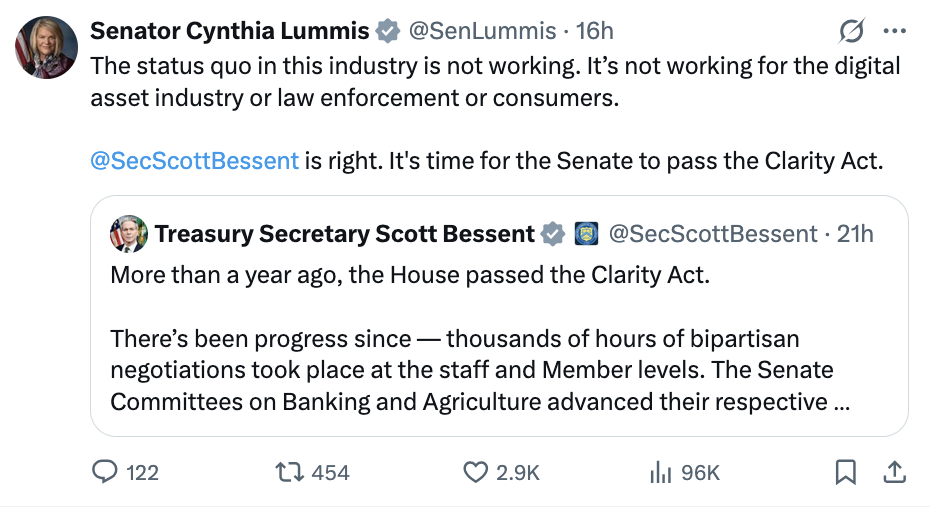
Senate CLARITY Act Negotiations Continue as Congress Tackles Remaining Issues
- Senators Thom Tillis (R-NC) and Ruben Gallego (D-AZ) submitted revised ethics provisions to the White House. The proposal would change the enforcement mechanism for a prohibition on federal officials issuing or sponsoring tokens by allowing state authorities, rather than the U.S. Attorney General, to enforce the restriction, though this mechanism has yet to be revealed publicly. The bipartisan counteroffer modestly improves the possibility of resolving a significant objection raised by Senate Democrats, but there is no reported confirmation that the White House accepted it, that the language has been finalized, or that it secured additional votes.
- Banking interests are seeking a stronger prohibition on stablecoin yield-like products, while cryptocurrency companies oppose restrictions that could encompass rewards programs. A bank-supported amendment that did not receive a committee vote could potentially be raised on the Senate floor. This dispute adds uncertainty to the coalition needed to begin and complete floor consideration.
Why this matters for Zcash
- For Zcash, the principal significance is whether resolution of the ethics dispute permits the CLARITY Act to advance. If the dispute remains unresolved, the Senate may not reach substantive provisions that could affect ZEC, exchanges, developers, wallets, or other ecosystem participants. The enforcement design may also affect the political durability of the overall package. If lawmakers consider the ethics mechanism credible, more senators may be willing to support the bill. If they consider state enforcement insufficient, fragmented, or legally uncertain, the proposal may fail to resolve the underlying objection. The supplied sources do not establish which assessment is more likely to prevail.
- The practical effect is consequently procedural rather than operational. A successful compromise could remove one barrier to Senate consideration of legislation that may ultimately affect Zcash. It does not itself change the legal treatment of ZEC or the operation of the Zcash protocol.
Action Item
We’re in the home stretch! Call your senators’ offices to advocate for the passage of the CLARITY Act with developer protections preserved and join the PGPZ Coalition Market Structure Working Group.
Relevant Post