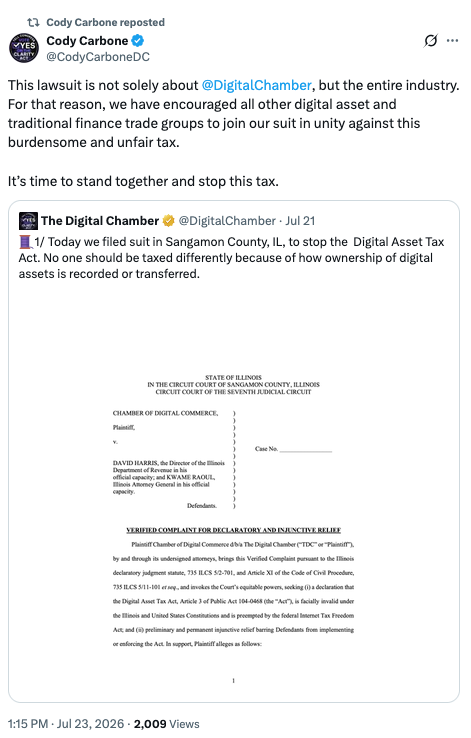
X Post of the Week
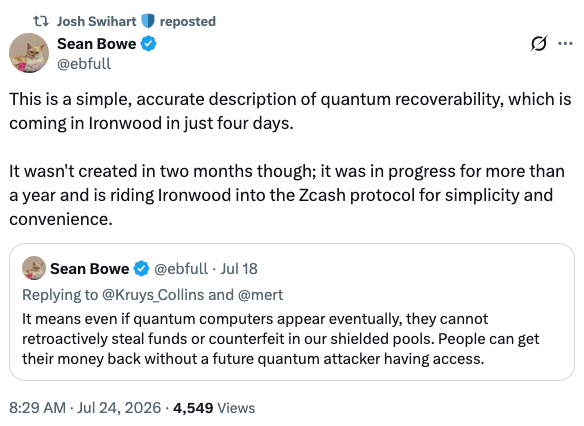
Senate CLARITY Act Negotiations Remain Constrained by Ethics and Scheduling Disputes
- Senate Republicans released a draft of the Digital Asset Market Clarity Act (CLARITY Act) that consolidates language from the Banking and Agriculture Committee, containing a new section on ethics to satisfy Democratic concerns.
- A group of Senate Democrats participating in the negotiations concluded in a joint statement that the consolidated draft does not adequately address ethics restrictions, consumer protection, illicit finance, conflicts of interest, or market integrity. Their position is significant because the Senate is expected to require 60 votes to invoke cloture, which limits debate and overcomes a filibuster so the chamber can move toward a final vote. The statement does not end negotiations, but it demonstrates that the current text lacks a reliable bipartisan coalition and therefore lowers the probability of immediate floor action.
- Senator Cynthia Lummis (R-WY) characterized release of the consolidated draft as an important procedural milestone, while acknowledging that the text remains negotiable. Republican and White House opposition to direct state attorney general actions appears to be a significant constraint, although alternative mechanisms involving enforcement against intermediaries remain under discussion. The consolidated draft improves procedural readiness but does not establish the votes necessary for passage.
- The White House argues that President Trump has accepted broad restrictions on the issuance or sponsorship of digital assets by senior government officials. The proposed provision would authorize civil penalties and federal enforcement, but it would principally rely on the Department of Justice. It would not provide direct enforcement authority to state attorneys general, and it would expire in January 2029, at the end of the current administration. The parties have therefore moved beyond whether an ethics provision should exist and are now disputing its enforceability and durability.
- Relatedly, President’s Council of Advisers on Digital Assets Executive Director Patrick Witt deferred National Guard legal training so that he could continue serving as the administration's principal negotiator during the expected Senate debate. His continued participation preserves institutional knowledge and reduces the risk of disruption at a sensitive stage. This is a modest positive development for negotiations, but it does not independently resolve disagreements over ethics enforcement, illicit finance, consumer protection, or the Senate schedule. The news comes as Harry Jung, the Council’s Deputy Director, announced he is leaving the administration.
Why this matters for Zcash
- The CLARITY Act would generally help the crypto industry, and the Zcash ecosystem, through a deliberate and thoughtful market structure framework that would task the CFTC with oversight over digital commodities.
- If ethics concerns are not addressed to Democrats’ satisfaction prior to August recess, the odds of the bill’s passage decrease significantly given the shrinking legislative window in August and the anticipated shift to high-priority legislative items such as funding packages. As a reminder, the timing around this vote is complicated because Congress will be heavily focused on the upcoming midterm elections in September and October.
Action Item
Call your senators’ offices to advocate for the passage of the CLARITY Act with developer protections preserved and join the PGPZ Coalition Market Structure Working Group.
Relevant Post
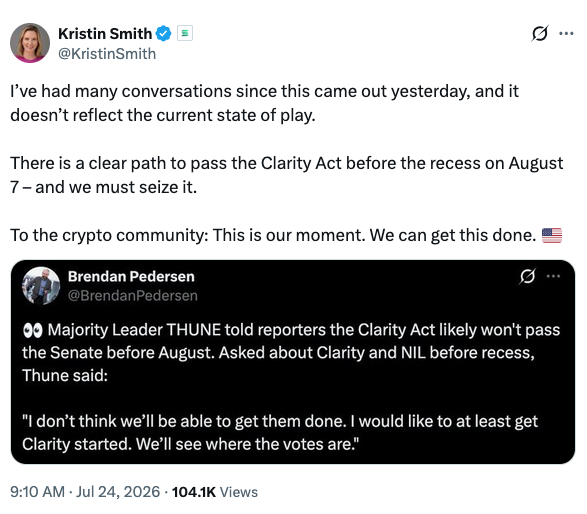
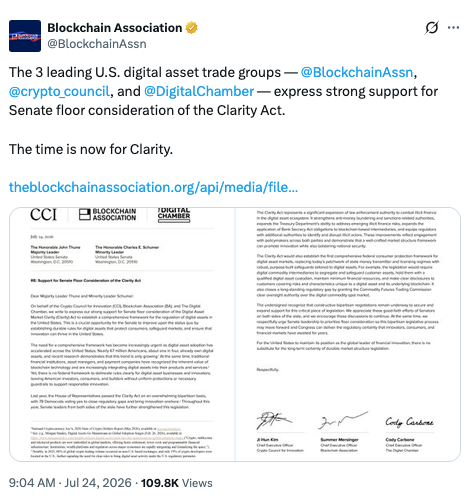
Crypto Industry Group Challenges Illinois Digital Asset Tax
The Digital Chamber, a digital asset trade association, sued the State of Illinois over its digital-asset tax provision that was enacted as part of the state budget shortly before the conclusion of the legislative session. The lawsuit seeks to prevent Illinois from enforcing the tax. The Digital Chamber contends that the statute violates the uniformity and due-process clauses of the Illinois Constitution, the Commerce Clause of the U.S. Constitution, and the federal Internet Tax Freedom Act.
The complaint’s central argument is that the tax distinguishes between transactions based on the technology used to record or process them. According to the filing, the statute does not differentiate between profitable and unprofitable transactions, realized and unrealized gains, or transfers that do and do not change ownership. Instead, it allegedly distinguishes between traditional financial infrastructure and blockchain infrastructure.
The Digital Chamber further argues that this distinction conflicts with the Internet Tax Freedom Act, which limits discriminatory state and local taxation of electronic commerce. The complaint maintains that federal law generally distinguishes assets according to their legal or economic characteristics rather than the technology used to record ownership.
Why this matters for Zcash
- This law affects Zcash users in Illinois who use centralized platforms like Coinbase, Kraken, and Gemini, as the platforms will be required to log every purchase, trade, or withdrawal of crypto, including Zcash, and tack on the 0.2% tax, including transfers from a custodial wallet to a noncustodial wallet.
- The law may impact users who use a noncustodial wallet’s internal swap functions, which rely on decentralized backend partners. While peer-to-peer transactions via noncustodial wallets would not be subject to the tax, the external liquidity providers, DeFi frontends, and market makers that execute the cross-chain swaps would likely be operating for-profit businesses because they collect fees. If these underlying protocols clear $100,000 in gross receipts from crypto trades originating in Illinois, the state will consider them "brokers." This may result in companies blocking Illinois residents or limiting available features via geofencing.
Action Items
- If you are in Illinois, call your local state representative and senator, framing the law’s implementation as a consumer privacy and data security issue. Explain that the law forces platforms to aggressively log and track the financial data of everyday citizens to prove whether they reside in Illinois, creating a massive honeypot for hackers. Push for a legislative amendment to clearly exempt noncustodial software and peer-to-peer transfers entirely.
- Monitor the case for any request for preliminary injunctive relief, the State of Illinois’ response, and clarification regarding the precise transactions and service providers covered by the tax. The court’s treatment of the Internet Tax Freedom Act claim will be particularly relevant to whether similar digital-asset taxes may be adopted by other states.
Relevant Post