
X Post of the Week
Fed Seeks Public Comment on NPRM to Modernize BSA
The Federal Reserve released for public comment a notice of proposed rulemaking (NPRM) that modernizes the Bank Secrecy Act (BSA) by requiring financial institutions to maintain dy-namic and explicitly "effective" Anti-Money Laundering and Countering the Financing of Terror-ism (AML/CFT) programs. The new framework would shift away from a static approach, by mandating continuous risk assessment, strict ongoing customer due diligence (CDD), and align-ment with government-issued AML/CFT priorities.
The rule would also increase accountability for financial institutions by requiring designated AML/CFT compliance officers to be located within the United States and readily accessible to regulators, while requiring that written compliance programs receive formal board approval. Consequently, U.S. financial entities would face severe penalties for failing to actively identify and mitigate the risks of illicit finance.
Comments are due on September 8, 2026.
Why this matters for Zcash
This rule will create more pressure for regulated U.S. exchanges that must register as financial institutions under the BSA that would be subject to these stricter ongoing due diligence requirements and would likely view shielded transactions as inherently high-risk. To avoid regulatory scrutiny and penalties, institutions may either require Zcash users to routinely use viewing keys to prove the origin of their funds, or they de-risk by delisting Zcash rather than building the complex infrastructure required to audit it.
Action Items
Repost and share this news to increase awareness of the NPRM and let us know if you have concerns about this proposed rule.
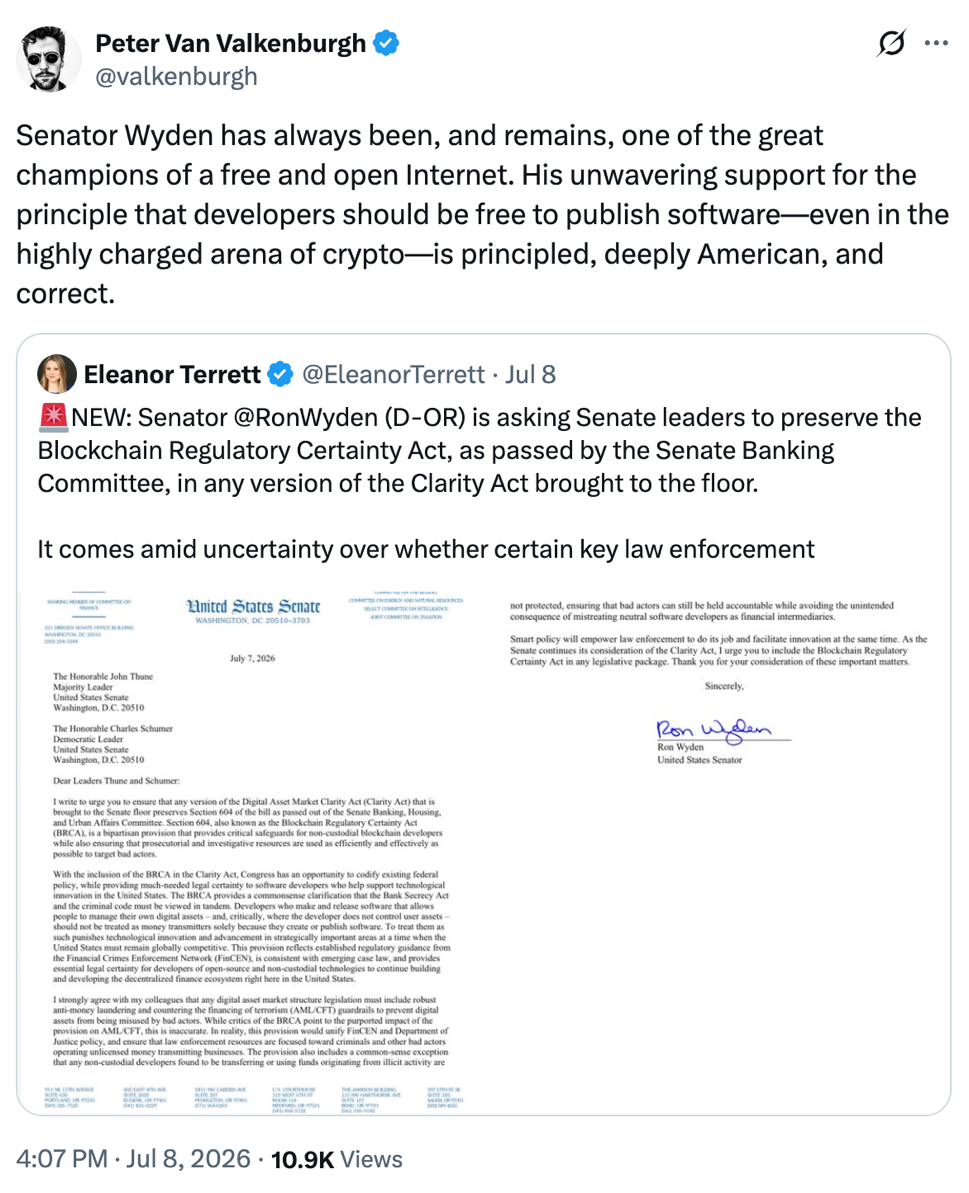
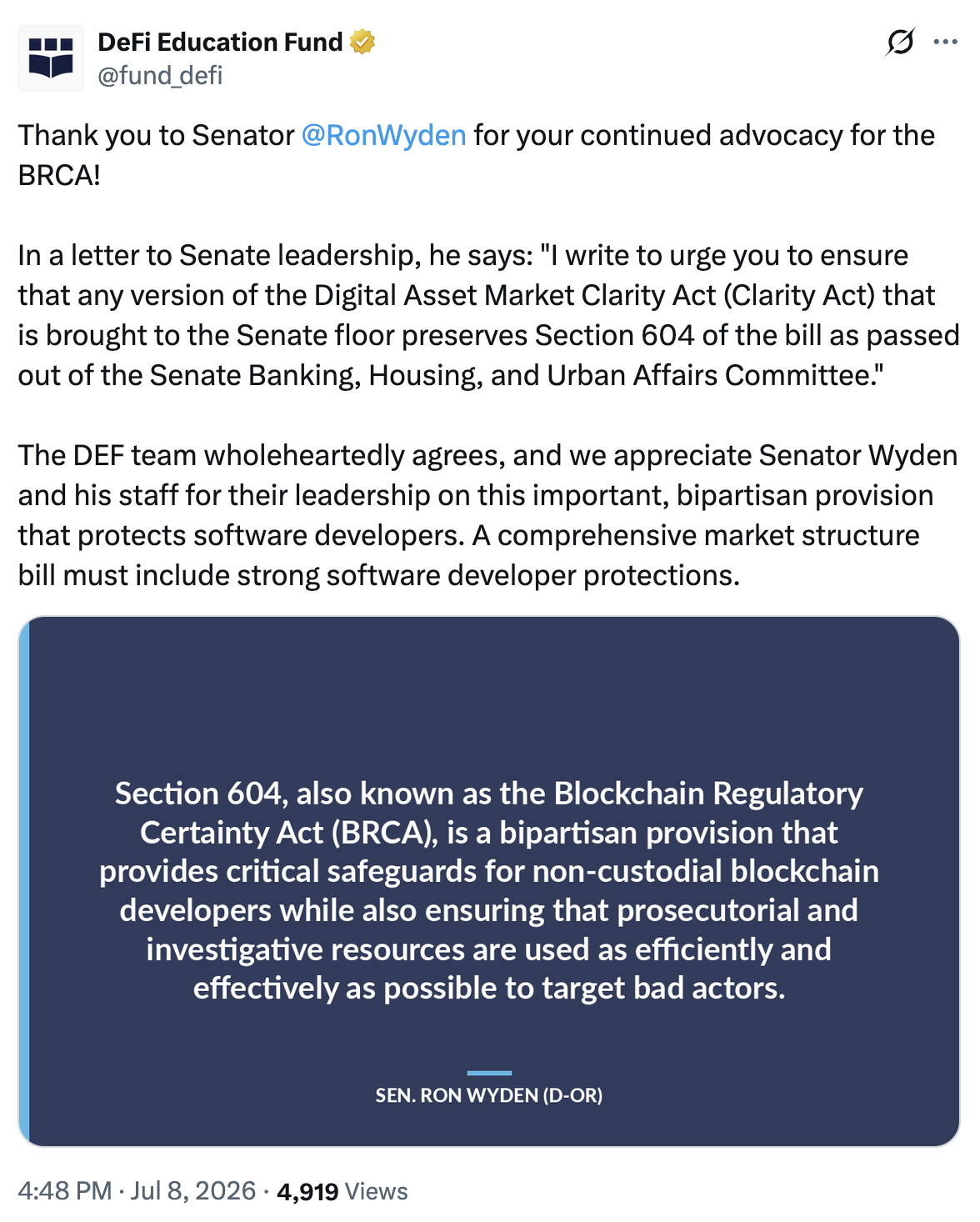
Senator Wyden Urges Preservation of BRCA in CLARITY Act
Senator Ron Wyden (D-OR) is urging Senate leaders to preserve the Blockchain Regulatory Certainty Act (BRCA) within the broader CLARITY Act. The BRCA aims to establish a clear le-gal safe harbor for developers of non-custodial and open-source software, ensuring they are not classified as "money transmitters" simply for creating tools that allow people to manage their own digital assets.
With the August Senate recess approaching and a crowded legislative calendar ahead of the midterm elections, the fate of both the BRCA and the overarching CLARITY Act remains highly uncertain.
Why this matters for Zcash
The fight over developer protections in the BRCA is an existential issue. Because Zcash relies on advanced, open-source zero-knowledge cryptography to provide non-custodial financial privacy, its core developers are precisely the types of entities this provision aims to protect. If the BRCA is stripped from the CLARITY Act, or if the bill fails to pass entirely, Zcash developers remain legally vulnerable to being classified as unlicensed money transmitters under aggressive U.S. enforcement actions, leading to a chilling effect.
Action Items
Call your Senators’ offices and ask them to support the CLARITY Act with the BRCA provisions included.
Relevant Posts
SEC Previews Proposed Rules for Crypto in 2026 Regulatory Agenda
The U.S. Securities and Exchange Commission (SEC) has released its 2026 Regulatory Agenda, in which it plans to introduce tailored rules and exemptions specifically for crypto as-sets. The agenda focuses on amending capital and recordkeeping requirements for broker-deal-ers and exchanges to accommodate digital assets. Importantly, the SEC plans to introduce rules that would clarify the issuance, custody, and trading of crypto assets, explicitly exploring safe harbors and confirming earlier guidance (issued jointly with the CFTC) that most cryptocur-rencies are not securities.
Why this matters for Zcash
This signal from the SEC shows it intends to codify guidance, such as the joint digital asset taxonomy it released with the Commodity Futures Trading Commission (CFTC). Codifying the guidance and moving forward with these proposed regulations would remove a massive cloud of uncertainty that has hung over Layer-1 tokens like Zcash. If ZEC is definitively treated as a commodity rather than an unregistered security, developers and exchanges must no longer fear arbitrary SEC enforcement actions simply for facilitating its trade.
Action Items
Repost and share this news to increase awareness of the SEC’s proposed rules and let us know if you have feedback about the concepts discussed in the regulatory agenda.